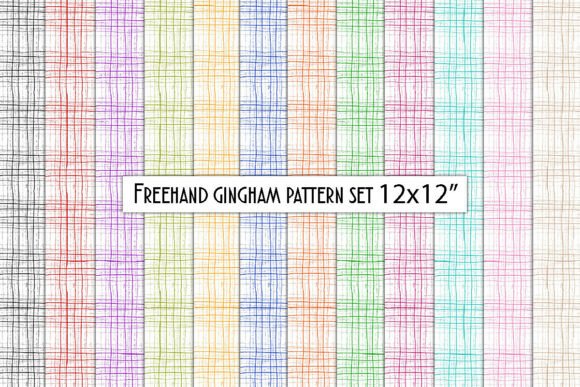
Freehand Gingham Pattern Set
The Freehand Gingham Pattern Set is a curated digital collection of 12 high-resolution pattern files, each designed with a hand-drawn aesthetic applied to the classic gingham grid. Unlike rigid, algorithmically generated checks, these patterns feature subtle irregularities in line weight, spacing, and alignment—evoking the warmth and authenticity of analog illustration. Delivered as JPG files at 3600 × 3600 pixels and 300 dpi, the set is optimized for both digital display and professional print applications.
Who Might Consider This Pattern Set?
Designers, crafters, and small-business owners often seek versatile, ready-to-use patterns that balance visual character with technical reliability. The Freehand Gingham Pattern Set appeals particularly to those who value texture and tactility in digital assets—especially when working on projects where machine-perfect repetition may feel too sterile. Common use cases include custom wrapping paper design, DIY stationery (e.g., party invitations or thank-you cards), fabric printing for home textiles or apparel, decoupage surfaces, and print-on-demand product mockups like phone cases or tote bags.
Practical Benefits
Each file in the set is seamless and tileable, meaning it can be repeated across large surfaces without visible breaks or misalignments. At 3600 × 3600 px and 300 dpi, the resolution supports sharp output on standard print formats up to approximately 12 × 12 inches at full size—and scales well for larger layouts when used with appropriate software interpolation. The hand-drawn quality adds visual interest without overwhelming adjacent typography or imagery, making it suitable for layered compositions.
The inclusion of 12 distinct variations—differing in scale, color density, and line nuance—offers flexibility across contexts. A lighter, sparser gingham may suit delicate stationery, while a bolder, denser version works well for upholstery or wall decals. Being delivered as a single ZIP archive simplifies download and organization, especially for users managing multiple asset libraries.
Tradeoffs and Technical Considerations
Because the patterns are raster-based JPGs—not vector or SVG files—they cannot be infinitely scaled without potential loss of clarity. While the 3600 × 3600 px dimensions accommodate most common print needs, users planning extremely large-format outputs (e.g., murals or billboard-sized textiles) may need to evaluate whether interpolation in editing software preserves desired detail.
JPG format also means no transparency support. If a project requires overlaying the pattern onto non-white backgrounds or blending with other layers using multiply or overlay modes, users will need to work around the solid white background—either by masking in Photoshop or converting to PNG manually (which introduces minor quality tradeoffs due to compression differences).
Additionally, the “freehand” aesthetic, while intentional, may not suit contexts demanding strict geometric precision—such as technical illustrations, architectural renderings, or branding systems requiring absolute consistency across touchpoints. Users prioritizing mathematical uniformity should assess samples carefully before committing.
When the Freehand Gingham Pattern Set Is a Strong Fit
This set performs best when the goal is to introduce organic warmth into otherwise structured layouts. It’s well-suited for:
- Craft-based small businesses producing limited-run printed goods (e.g., handmade greeting cards, fabric-covered journals, or seasonal gift wrap);
- Interior designers developing mood boards or mockups for textile-heavy spaces, where tactile authenticity supports client communication;
- Digital product designers creating cohesive UI/UX assets for lifestyle or wellness apps, where soft, approachable patterns reinforce brand tone;
- Educators or workshop facilitators teaching surface pattern design—using the set as a reference for how hand-drawn qualities translate into repeatable digital motifs.
When Alternatives May Be Worth Exploring
If your workflow relies heavily on scalable graphics—for example, designing logos, signage, or embroidery digitizing—the absence of vector versions limits adaptability. In such cases, a vector-based gingham pack (e.g., AI or EPS files) may offer greater long-term utility.
Similarly, if color customization is essential—such as matching exact brand Pantones or adapting patterns for dark-mode interfaces—the JPG format requires manual recoloring in image-editing software. Pattern sets delivered as layered PSD files or with editable color swatches would streamline that process.
For users needing extensive licensing coverage—particularly for resale of physical products through major platforms like Etsy or Amazon—reviewing the included license terms is critical. Not all pattern sets permit commercial redistribution, and some restrict usage to end products only (e.g., you may print the pattern on a bag to sell, but not resell the pattern file itself). Confirming permitted use cases avoids compliance issues later.
Making an Informed Decision
Before choosing the Freehand Gingham Pattern Set, consider three practical questions:
- What’s the primary output medium? If most projects involve digital screens or standard print sizes (A4, letter, 12″ × 12″ fabric swatches), the resolution and format are appropriate. For oversized or vector-dependent applications, verify compatibility first.
- How important is editability? If you regularly adjust colors, isolate elements, or combine motifs, evaluate whether the JPG-only delivery meets your editing pipeline—or whether supplemental conversion steps are feasible.
- Does the aesthetic align with your audience’s expectations? Test a sample against existing brand assets or past projects. Does the hand-drawn looseness complement your visual language—or clash with established precision?
Downloading and previewing a representative file (if offered) helps ground these assessments in actual usage—not just theoretical fit. Many creators find it useful to import one pattern into their usual design environment (e.g., Adobe Illustrator, Affinity Designer, or Canva) to test tiling behavior, scaling response, and layer interaction before purchasing the full set.
Final Thoughts
The Freehand Gingham Pattern Set fills a specific niche: delivering artisanal texture in a technically sound, immediately deployable format. Its strength lies not in universal applicability, but in thoughtful alignment with projects where human imperfection enhances rather than detracts from professionalism. For users whose goals center on warmth, approachability, and tactile resonance—without sacrificing production readiness—it represents a practical, focused resource. As with any digital asset, its value emerges most clearly when matched deliberately to real-world constraints and creative intentions.