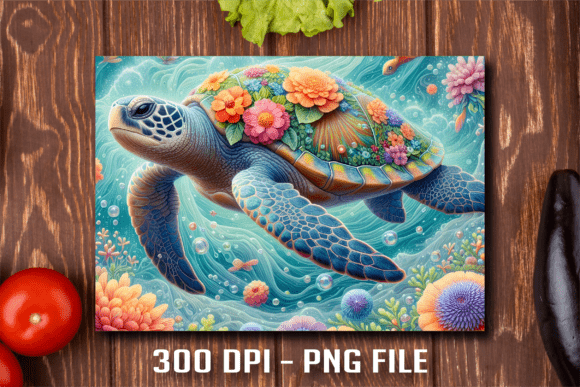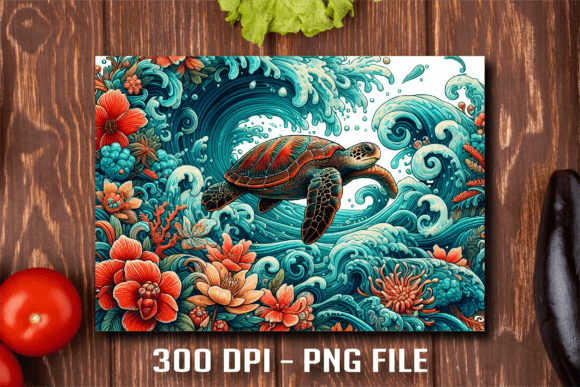
Ocean Wave Turtle Cutting Board
There’s a quiet power in objects that do more than one thing well—especially in the kitchen. The Ocean Wave Turtle Cutting Board isn’t just a surface for slicing herbs or serving cheese. It’s a strategic tool: a high-resolution, sublimation-ready design built to support intentionality—not just in craft, but in positioning, storytelling, and value delivery. Whether you’re launching a small-batch kitchen goods line, curating thoughtful housewarming gifts, or building a cohesive brand identity around coastal calm and mindful living, this design serves as both foundation and amplifier.
Why This Design Fits Real-World Goals—Not Just Aesthetic Trends
Sublimation isn’t about printing pretty pictures. It’s about embedding meaning into functional objects—so the design must carry weight *and* work technically. The Ocean Wave Turtle Cutting Board succeeds here because its composition balances visual rhythm (the gentle arc of the wave), symbolic resonance (the turtle as a marker of patience, longevity, and grounded movement), and technical readiness (300 DPI resolution, precise 11.6 in × 8.2 in dimensions). That means less time troubleshooting bleed or pixelation—and more time focusing on what matters: who you’re serving, why this piece fits their life, and how it aligns with broader goals like customer retention, gift memorability, or brand consistency.
For small business owners, that translates directly into operational leverage. When your sublimation files are pre-validated for clarity and scale, you reduce trial runs, minimize material waste, and speed up fulfillment—without sacrificing quality. For creators gifting handmade items, it means confidence: no last-minute resizing, no blurry edges on a wood grain background, no mismatched proportions on a glass board. You invest once—in a reliable, field-tested asset—and reuse it across contexts with predictable results.
Strategic Use Cases: Where Intentional Placement Matters Most
The Ocean Wave Turtle Cutting Board shines when matched to purpose—not just surface type. Consider these scenarios:
- Personalized kitchen gifts: A newlywed couple who surfed their first date? A retiree who volunteers with sea turtle conservation? The design becomes a quiet nod—not generic decor, but contextual recognition. That distinction builds emotional resonance far beyond the transaction.
- Branded merchandise for coastal businesses: A boutique café in Newport or a sustainable seafood market in Portland can use this design on charcuterie boards served tableside—then offer matching retail versions. The continuity bridges experience and ownership, turning a moment into a memory with shelf life.
- Recipe or meal-prep boards: When mounted vertically as a wall-mounted recipe board (on wood or tempered glass), the wave-turtle motif subtly reinforces themes of flow, balance, and natural rhythm—aligning food philosophy with visual language. No slogan needed. The design communicates tone.
What ties these together isn’t the turtle alone—it’s how the wave’s motion guides the eye, creates negative space for text or garnish placement, and leaves room for interpretation. That flexibility is strategic: it allows adaptation without rebranding, personalization without redesign.
Planning Your Execution: What to Confirm Before Pressing “Print”
A high-quality PNG doesn’t guarantee great output—it guarantees potential. Realizing that potential depends on alignment between file, substrate, and process. Before sublimating the Ocean Wave Turtle Cutting Board, verify three things:
- Substrate compatibility: Not all wood blanks absorb sublimation ink evenly; some glass boards require specific coatings. Run a test on your exact blank—even if it’s from the same supplier—especially if you’re batching for clients or gifting. Grain direction, surface sealant, and pre-press moisture levels all affect vibrancy and edge fidelity.
- Color context: The design was created for contrast and clarity—but your base material’s tone changes perception. A warm walnut will mute cool blues in the wave; a frosted white glass may soften definition. Adjust expectations—or consider light/dark variants—if consistency across materials is part of your promise.
- Usage intent: Is this board meant for daily prep, display-only, or ceremonial use (e.g., wedding cake cutting)? If function matters, prioritize food-safe finishes post-sublimation and avoid designs that place key elements near knife-contact zones. The turtle’s head sits intentionally toward the top third—away from typical chopping lines. That’s not accidental. It’s planning.
Risks of Using Without Context—And How to Avoid Them
The biggest risk isn’t technical failure—it’s misalignment. Using the Ocean Wave Turtle Cutting Board as filler (“I need something ocean-themed”) dilutes its strength. Turtles appear everywhere: on mugs, stickers, yoga mats. What makes this version distinct is its compositional discipline—the wave’s curve guiding gaze left-to-right like reading, the turtle’s shell echoing the wave’s crest, the balanced negative space inviting interaction rather than passive viewing.
Without anchoring it to a clear “why,” you default to decoration. And decoration competes. But when tied to narrative—say, a marine biologist’s home kitchen, a coastal wellness retreat’s guest welcome kit, or a zero-waste chef’s toolkit—it becomes a signal. Signals build trust. Trust compounds over time.
Another subtle risk: assuming digital perfection equals physical readiness. A 300 DPI PNG renders cleanly on screen—but if your heat press temperature fluctuates by 10°F or dwell time varies by 2 seconds, results shift. Document your ideal settings *with this specific file*, not just “generic sublimation guidelines.” Treat the Ocean Wave Turtle Cutting Board as a calibrated instrument, not a plug-and-play graphic.
Long-Term Value: Beyond the First Batch
This design pays dividends over time—not because it’s trendy, but because it’s modular. You can pair it with complementary elements: a minimalist wave-only variant for smaller coasters, a monochrome turtle outline for linen napkin embroidery, or even reverse the color scheme for dark-surface applications. Because the original file is clean, layered (in source form), and proportionally sound, expansion feels native—not forced.
For educators or content creators, it also functions as a teaching anchor. Demonstrating sublimation workflow? This design highlights how resolution, dimension, and subject placement impact real-world usability. Showing students how symbolism supports branding? The turtle-wave duality offers rich ground for discussion—without needing proprietary case studies.
Most importantly, it supports sustainability of effort. One purchase gives instant access to a production-ready asset—no subscription, no usage caps, no attribution requirements. That autonomy matters when you’re balancing multiple roles: maker, marketer, parent, project manager. Time saved on asset prep is time redirected toward refinement, outreach, or rest.
Final Thought: Let the Design Serve Your Clarity
The Ocean Wave Turtle Cutting Board works best when it reflects something already true—not when it tries to invent meaning from scratch. If your brand centers on slow living, it echoes that. If your gifting philosophy prioritizes personal significance over polish, it accommodates that. If your small business thrives on repeat customers who recognize your visual voice across products, it strengthens that.
That’s the quiet advantage: it doesn’t ask you to adapt to it. It invites you to clarify what you stand for—and then hold space for it, cleanly and confidently, on wood, glass, or countertop.