Flower Bouquet Line Art Vector
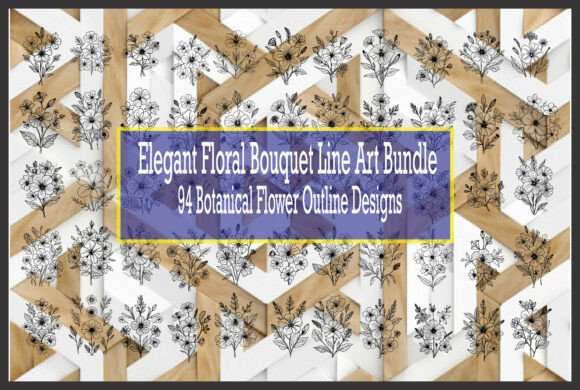
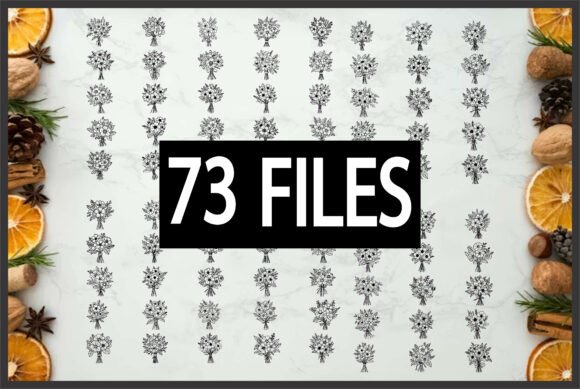
Imagine opening a digital toolbox filled with 73 distinct, hand-drawn floral bouquets—each one clean, intentional, and ready to adapt. That’s what the Flower Bouquet Line Art Vector bundle delivers: a thoughtfully curated collection of minimalist botanical outlines designed for real-world making—not just browsing.
These aren’t generic clip art flowers. Each bouquet is individually composed—some tied with ribbon, others cascading loosely; some dense and formal, others airy and wildflower-inspired. The line work is consistent in weight and clarity, optimized for both precision cutting and expressive coloring. And because every design comes in six formats—SVG, PNG, EPS, AI, JPG, and PDF—you’re never limited by your toolset or platform.
Creative Flexibility, Built In
The strength of this bundle lies in its format versatility. Need crisp vector paths for Cricut Design Space or Silhouette Studio? The 73 SVG files import cleanly, retain layers, and scale infinitely without pixelation. Working in Adobe Illustrator on a branding project? The 73 AI files open with editable strokes, grouped elements, and named layers—ideal for customizing stem length, adjusting petal spacing, or swapping in client-specific fonts for monogrammed wedding stationery.
For print-on-demand creators, the 73 high-resolution PNGs (transparent background, 300 DPI) drop straight into Canva, Printful, or Redbubble mockups. Educators building classroom resources can use the PDF versions as printable coloring pages—no software required. And if you're laser-cutting wooden coasters or engraving acrylic charms, the EPS files maintain anchor points and path integrity across industrial-grade software.
Real Projects, Real Users
Wedding professionals use these bouquets to craft cohesive suites: a single line art motif appears as a foil-stamped detail on invitations, repeats as a subtle watermark on menu cards, then reappears as a cut-out stencil on table numbers. Because all 73 designs share the same stylistic language—clean lines, balanced negative space, and organic flow—they feel intentional, not repetitive.
Adult coloring book designers appreciate how each bouquet balances complexity and calm. Some feature intricate layered petals for experienced colorists; others use bold, simplified shapes perfect for beginners or therapeutic focus. You can mix and match across seasons—pair spring tulips with summer peonies in a single spread, or isolate stems for border patterns that guide the eye without overwhelming.
Small business owners selling handmade goods find immediate utility here. A florist might embed a subtle line art bouquet into their Instagram story template. A candle maker could layer one over soy wax photography for a clean product label. A scrapbook supply brand uses the PNGs as digital embellishments—then converts the same SVGs into physical die-cut stickers for packaging.
How to Use It Without Losing Your Voice
Having 438 files is powerful—but only if you use them with purpose. Start by filtering: pick three bouquets that reflect your current project’s mood—elegant and structured, loose and garden-fresh, or tightly clustered and graphic. Then ask: What does this need to *do*?
- If it’s for cutting, test the SVG in your machine’s software first—check for stray anchor points or overlapping paths. Most files are pre-optimized, but a quick “outline stroke” and “unite” in Illustrator ensures clean cuts every time.
- If it’s for coloring pages, print one at actual size and sketch over it with pencil. Does the line weight hold up? Are intersections clear? These designs were drawn with that balance in mind—thin enough for detail, thick enough for confident tracing.
- If it’s for branding, try recoloring one bouquet in your palette using global swatches. Does it still read as floral? Does it retain legibility at small sizes? The minimalism here works *because* it’s deliberate—not stripped down, but distilled.
Thoughtful Adaptation Over Quick Replacement
This isn’t about dropping in a flower and calling it done. It’s about using line art as a foundation—not a finish. A teacher creating a botany unit might add scientific labels to petals and stamens using the AI file. A greeting card designer might rotate and mirror two bouquets to create symmetrical framing around handwritten text. A textile artist could import the SVG into embroidery software, adjust stitch density, and translate the outline into satin stitch borders.
Even simple edits make a difference: duplicate a bouquet, reduce opacity to 20%, and place behind a photo for a soft botanical overlay. Or extract just the ribbon tie from one design and pair it with stems from another to build a custom arrangement. Because everything is vector-based and consistently styled, combinations feel unified—not patched together.
For Consistency Across Formats and Audiences
When sharing across platforms—say, an Instagram post, a printable planner, and a physical workshop handout—use the same base bouquet. Export the SVG for digital editing, the PNG for social media, and the PDF for printing. That continuity builds recognition and trust. Your audience doesn’t need to know it’s the same file—they’ll sense the cohesion.
And for educators or content creators publishing free resources: include attribution guidance in your download notes. A simple “Line art by [Your Name], adapted from Flower Bouquet Line Art Vector bundle” maintains transparency while honoring the original design work.
Not Just Flowers—A Starting Point
What makes this bundle enduring isn’t the number of files—it’s how each one invites action. It supports quiet creativity (a teenager filling in petals after school), professional efficiency (a freelancer delivering five custom wedding concepts in under two hours), and collaborative learning (a community center group screen-printing bouquets onto tote bags).
You don’t need to master every format to begin. Pick one use case—coloring page, sticker sheet, or monogram frame—and explore just three files in that context. See how the line weight behaves when scaled. Notice how negative space guides where color naturally pools. Let the simplicity do the work, so you can focus on meaning, message, and making.
That’s the value of well-crafted line art: it removes friction, not possibility. With Flower Bouquet Line Art Vector, the flowers are drawn. Now it’s your turn to decide where they grow.