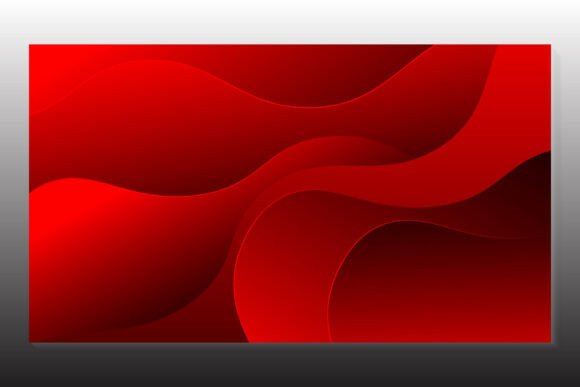
Why the Abstract Red Liquid Wave Background Is a Smart Choice for Modern Design Projects
Designers today juggle tight deadlines, evolving brand guidelines, and platforms that demand pixel-perfect versatility. Whether you're crafting a social media campaign, building a presentation deck, or designing product cards for an e-commerce site, your background assets need to do more than just look good — they need to adapt, scale, and integrate seamlessly. That’s where the Abstract Red Liquid Wave Background stands out: not as a static image, but as a flexible, production-ready design asset engineered for real-world use.
More Than Just a Pretty Pattern — A Workflow Accelerator
At first glance, the Abstract Red Liquid Wave Background delivers visual impact: fluid, organic movement in rich red tones evokes energy, passion, and modern sophistication. But its true value lies beneath the surface — in its vector foundation. With 100% vector construction, every curve, gradient, and wave is mathematically defined, meaning it scales infinitely without blurring, distortion, or quality loss. Whether you’re printing a 6-foot trade show banner or cropping a tiny Instagram story thumbnail, the integrity remains intact.
This isn’t just theoretical. Imagine preparing assets for a client who needs the same background across five touchpoints: a LinkedIn cover photo (1584×396 px), a PowerPoint slide background (1920×1080), a set of email newsletter headers, printed business cards, and a Shopify product page hero section. With raster-based backgrounds, you’d be juggling multiple sizes, manually adjusting contrast, and risking inconsistency. With the Abstract Red Liquid Wave Background, one EPS file handles them all — no re-exporting, no guesswork.
Effortless Customization — Color, Scale, and Context
Red is powerful — but it’s not always *right*. Brand palettes shift. Seasonal campaigns call for variation. Client feedback might ask for “something warmer” or “a little more muted.” Here’s where the editable nature of this background shines. Because it’s built in vector format (EPS 10), opening it in Adobe Illustrator gives you full control over every element:
- Swap the red in seconds using the Recolor Artwork tool or by selecting individual swatches — no need to recreate gradients from scratch.
- Adjust wave density or flow direction by tweaking anchor points or applying new blend modes — ideal when matching motion graphics or UI transitions.
- Isolate sections to use only part of the wave pattern — say, the lower third for a subtle footer background or a single looping segment for animated web elements.
- Resize non-destructively at any stage, even after adding text or icons on top — crucial when iterating with stakeholders or responding to layout changes.
And because a JPEG preview is included, you can quickly share a visual reference with team members or clients who don’t have Illustrator — no confusion about how the final output will appear.
Where This Background Fits Best — Real Use Cases
The Abstract Red Liquid Wave Background isn’t a one-size-fits-all solution — it’s a purpose-built tool for specific creative needs. Knowing where it adds the most value helps avoid mismatched applications and wasted time.
Social Media Banners & Profile Headers
Platforms like Twitter (X), Facebook, and YouTube have strict dimension requirements and high visibility. A flat, repetitive tile won’t cut it — but a dynamic, asymmetrical wave creates instant visual hierarchy. The red tone draws attention without overwhelming profile photos or logos placed over it. Bonus: since the wave flows diagonally, it naturally guides the eye toward your CTA button or bio link.
Marketing Cards & Digital Postcards
Whether used for event invites, limited-edition product launches, or email campaign teasers, cards benefit from depth and movement. Unlike solid-color or noise-based backgrounds, the Abstract Red Liquid Wave Background adds tactile dimension — suggesting texture and motion even in static formats. It also pairs exceptionally well with clean, bold typography, letting headlines pop without competing for dominance.
Presentation Slides & Pitch Decks
Avoid the “death by bullet point” trap. A subtle, full-bleed wave background behind concise content signals confidence and creativity — especially in pitch decks for tech startups, creative agencies, or wellness brands where emotion and aesthetics matter. Since the pattern avoids central symmetry, it doesn’t distract from data charts or speaker notes placed in standard safe zones.
Web & App UI Elements
While full-page backgrounds require careful performance optimization, portions of this wave can serve as hero section accents, section dividers, or interactive hover states. Export individual wave segments as SVGs for lightweight, responsive integration — no HTTP requests for heavy JPEGs, and full CSS color control via fill attributes.
What You Need to Know Before Using It
To get the most from the Abstract Red Liquid Wave Background, keep these practical considerations in mind:
- Software matters: For full editability, use Adobe Illustrator (CS6 or newer). While other vector editors may open EPS files, Illustrator ensures accurate rendering of gradients, transparency, and layer structure. If you’re using Affinity Designer or Figma, import the JPEG preview for placement — then manually recolor or trace key shapes if needed.
- Color mode awareness: The EPS file is typically delivered in RGB — ideal for digital use. For print projects, convert to CMYK *after* editing and check for unintended shifts in red saturation. Soft-proofing against your printer’s profile is recommended.
- Text legibility is non-negotiable: Red-on-red or light text over bright wave highlights can fail accessibility standards. Always test contrast ratios (aim for at least 4.5:1) using browser tools or plugins like Stark. Consider adding a subtle semi-transparent overlay or using the background at reduced opacity behind copy blocks.
- Licensing clarity: Confirm whether your license permits commercial use, resale in templates, or modification for client work. Most reputable marketplaces grant broad usage rights — but double-check before bundling into a SaaS dashboard theme or white-labeled toolkit.
How It Compares to Alternatives
You’ll find countless “liquid,” “wave,” and “abstract red” backgrounds online — but many are raster-only, low-resolution, or locked in rigid compositions. Others rely on complex Photoshop layer stacks that break when resized. The Abstract Red Liquid Wave Background avoids those pitfalls by prioritizing vector fidelity and intentional simplicity. It doesn’t try to be everything — no photorealistic splashes, no 3D extrusions, no excessive noise. Instead, it focuses on what designers actually need: a clean, expressive, scalable foundation that enhances rather than overwhelms.
Compared to generative AI backgrounds, it offers predictability and precision. No waiting for outputs, no inconsistent style between variations, no copyright gray areas. You know exactly what you’re getting — and how to shape it to your exact needs.
Final Thought: Design Assets Should Serve Your Process — Not Slow It Down
In fast-moving creative environments, friction is the enemy. Every minute spent fixing blurry exports, reworking colors, or hunting for compatible formats is a minute stolen from ideation, refinement, or client collaboration. The Abstract Red Liquid Wave Background removes friction by design — delivering professional-grade flexibility without complexity. It respects your time, your tools, and your standards. And when your next project calls for energy, elegance, and effortless adaptability, it’s ready — not as decoration, but as infrastructure.