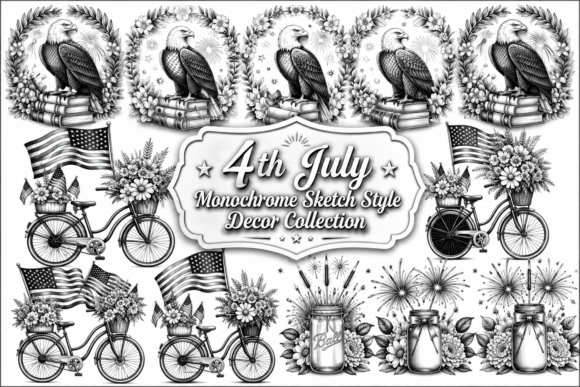
4th of July Monochrome Sketch Style Set
There’s a quiet shift happening in how creators approach patriotic design—not toward louder saturation or retro clichés, but toward refined intentionality. The 4th of July Monochrome Sketch Style Set responds directly to that shift: ten meticulously hand-drawn, black-and-white illustrations—patriotic baskets, fireworks bursting mid-air, crisp American flags, stoic bald eagles, solemn liberty bells, delicate roses entwined with bunting, and layered vintage Americana motifs—all rendered in expressive, detailed line work. No color distractions. No digital noise. Just clarity, contrast, and craft.
A Design Language That Prioritizes Meaning Over Mass
Monochrome sketch styling isn’t just an aesthetic choice—it’s a functional one. In an era where audiences scroll faster and attention spans compress, high-contrast black-and-white illustration cuts through visual clutter without sacrificing warmth or personality. These aren’t sterile vector icons or overused stock silhouettes. Each design in the set carries subtle texture, intentional lineweight variation, and compositional balance—qualities that signal authenticity and care to discerning viewers.
Consider a small-batch candle maker launching a limited Independence Day collection. Instead of overlaying a generic flag graphic on a label, they use the monochrome sketch-style American flag—scaled thoughtfully, printed on kraft paper with soy ink. The result feels artisanal, grounded, and quietly confident. That same flag clipart works equally well as a watermark on a digital invitation suite or as a repeating motif on wedding stationery for a rustic-chic July 4th elopement. Its versatility stems from its restraint.
Why Print-Ready Resolution Matters More Than Ever
Many designers still juggle mismatched assets—low-res web graphics stretched for packaging, watermarked downloads repurposed across platforms, or inconsistent line weights across formats. The 4th of July Monochrome Sketch Style Set eliminates that friction. Every clipart arrives at 5120px × 5120px, 300 DPI, with fully transparent backgrounds. That means no pixelation when scaled to a 12" × 12" scrapbook page—or when reduced to a 1.5" icon on a product tag. It also means seamless integration into professional print workflows: CMYK prepping, spot-color separation, foil stamping mockups, or letterpress plates all begin with clean, high-fidelity source files.
This level of technical readiness reflects a broader expectation: creators no longer want “good enough” assets—they want production-grade tools that respect their time and standards. A freelance graphic designer preparing seasonal social media templates for a boutique retailer can drop the monochrome fireworks clipart into a Canva layout, adjust opacity for subtle layering, and export at full resolution for Instagram Stories *and* PDF lookbooks—without re-exporting, resampling, or compromising fidelity.
From Nostalgia to Narrative: Vintage Americana Done Thoughtfully
The inclusion of motifs like liberty bells, rose-strewn baskets, and engraved-style eagles nods to heritage—but avoids pastiche. These aren’t caricatures lifted from 1940s propaganda posters. They’re reinterpretations: the bald eagle drawn with feathery precision rather than rigid symbolism; the liberty bell softened by fine cross-hatching that suggests age without decay; roses sketched with botanical accuracy, not stylized abstraction. That nuance invites storytelling—not just celebration, but reflection.
Educators developing a U.S. history unit on civic symbols might use the liberty bell and flag designs in printable worksheets, pairing them with primary source excerpts. Bloggers writing about sustainable celebrations could feature the patriotic basket clipart beside tips for zero-waste picnics—its woven texture reinforcing themes of craft and care. Even wedding planners curating Fourth of July micro-weddings lean into this tone: using the roses and bunting composition on save-the-dates to evoke romance *and* reverence, not just festivity.
How Transparency (and Technical Clarity) Enables Real Workflow Efficiency
The fully transparent background isn’t just convenient—it’s foundational to modern design flexibility. Whether you’re building layered digital papers for Procreate, designing die-cut labels in Adobe Illustrator, or applying subtle watermark effects in Photoshop, transparency removes guesswork. There’s no need to manually remove white backgrounds, match corner radii, or troubleshoot anti-aliasing halos. You place, scale, recolor (if desired), and move forward.
This simplicity supports real-world constraints: tight deadlines, multi-platform publishing, and cross-disciplinary collaboration. A marketer preparing email banners, social ads, and in-store signage for a July promotion can use the same fireworks clipart across all three—adjusting blend modes for dark-mode emails, converting to SVG for web animation, or embedding in a print-ready PDF—knowing the asset behaves predictably at every stage.
Practical Integration Across Creative Domains
The strength of the 4th of July Monochrome Sketch Style Set lies in its quiet adaptability—not in forcing itself into every project, but in fitting seamlessly where it’s needed most. Here’s how professionals are already applying it:
- Product packaging teams use the patriotic basket and roses designs as subtle background textures on limited-edition snack boxes or artisanal jam jars—elevating shelf presence without overwhelming the product.
- Scrapbookers and memory-keepers layer the liberty bell and flag cliparts onto scanned photos from past Independence Day gatherings, creating heirloom-quality albums that feel personal, not generic.
- Wedding stationers combine the bald eagle outline with serif typography for ceremony programs, letting the illustration anchor the layout without competing with text.
- Digital paper designers tile the fireworks motif at low opacity to create dynamic, tonal backgrounds for printable planners or journal inserts—adding thematic resonance without visual fatigue.
- Educational content creators import the monochrome flag and eagle into interactive PDFs or classroom slides, annotating key features to teach symbolism, proportion, and historical context.
Looking Ahead: Simplicity as Strategic Differentiation
As design tools become more accessible—and template-based solutions more abundant—the value of distinctive, human-made assets continues to rise. The 4th of July Monochrome Sketch Style Set doesn’t chase algorithmic virality or trend-chasing novelty. Instead, it offers something increasingly rare: consistency of voice, technical reliability, and quiet sophistication. It assumes the user is capable, intentional, and values substance over speed.
That mindset aligns with where creative work is headed—not toward more complexity, but toward more considered choices. Whether you’re prototyping a new product line, designing a community event poster, or crafting a meaningful family tradition, these illustrations don’t shout. They support. They clarify. They endure.
And because they arrive print-ready, transparent, and scalable, they meet creators where they are—whether working in a home studio, a co-op design lab, or a global brand’s in-house team—without asking them to compromise on quality, control, or context.